Murder of Joe Brody
The Big SleepThe Murder of Joe Brody turns the investigation of Arthur Geiger’s death into a second homicide: Carol Lundgren kills Brody because he mistakes him for Geiger’s killer. The shooting exposes the cost of Philip Marlowe’s silence about the first murder, and its aftermath reveals how police and newspapers can settle on a clean account while leaving crucial connections out of view.
Causes and Background
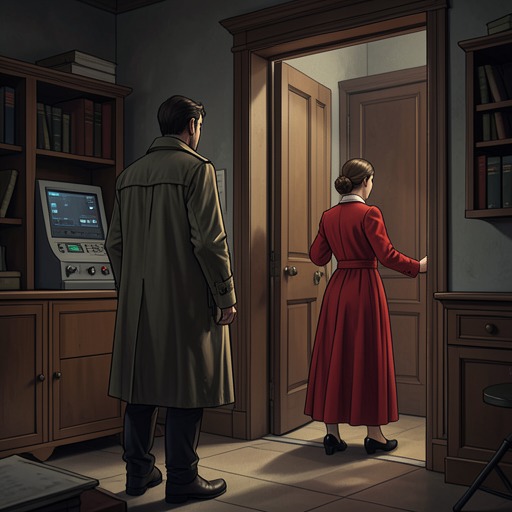
Brody has taken over Geiger’s illicit book business and possesses material connected to the blackmail of the Sternwood family. Marlowe confronts him about the disappearance of Geiger’s body, but Brody dismisses the accusation. The matter is interrupted when his door buzzer rings again. Brody assumes the visitor is a woman who has been troubling him, then arms himself with a Colt and approaches the door cautiously, holding the gun against his thigh.
The visitor calls Brody by name. Brody replies, but Marlowe cannot hear what he says. Two muffled shots follow. Brody falls against the door, which closes under his weight, and slides down it. The Colt remains in his hand. The brief encounter ends without a warning or an explanation that Marlowe can make out; the visitor has killed Brody before Marlowe can intervene.
Pursuit and Identification
Marlowe forces his way through the doorway and follows the fleeing killer down the tiled steps and out to the street. The figure is tall, hatless, and wearing a leather jerkin. When the fugitive turns and fires, the shots strike the stucco wall beside Marlowe. The runner escapes between parked cars before Marlowe can catch him immediately.
Marlowe circles back and waits for the sound of footsteps and cheerful whistling. When the young man reappears, Marlowe steps out and confronts him with Carmen Sternwood’s small revolver. He recognizes him as the handsome young man he had seen at Geiger’s store. The boy gives his name as Carol Lundgren. Marlowe tells him that he has shot the wrong man: Brody did not kill Geiger.
Lundgren does not explain himself. Marlowe takes him away in the car toward Laverne Terrace. The capture makes the central mistake plain: Lundgren has acted to avenge Geiger, but has chosen Brody as the wrong target. The case’s prior connections—notably the movement of Geiger’s books to Brody—have placed the two men in the same chain of violence.
Investigation and Responsibility
At the police inquiry, Bernie Ohls asks Lundgren whether he admits shooting Brody. Marlowe says an admission is unnecessary because he has Lundgren’s gun. Captain Cronjager’s account of the scene is comparatively thin: Brody is dead from two shots, two guns that had not been fired are found, and a blonde woman is detained after being discovered trying to start a car that was not hers. She says she was present when Brody was killed but did not see the killer. Cronjager describes the suspect only as a tall man in a leather jerkin.
Ohls supplies the missing link by bringing in the handcuffed Lundgren and his automatic. The murder investigation is now joined to the earlier crimes around Geiger and the wealthy family he blackmailed. Ohls tells Cronjager that the chauffeur of a rich family has also been found dead in a car recovered from the Pacific near Lido Pier, and that the family had been blackmailed over one of its daughters. The separate cases are not, in fact, the simple sequence they will later become in the newspapers.
Cronjager accuses Marlowe of failing to report Geiger’s murder the previous night and of spending the next day maneuvering while Lundgren went on to kill Brody. Marlowe acknowledges the charge and says he was trying to protect his client; he had not expected Lundgren to attack Brody. Cronjager argues that reporting Geiger’s death would have prevented the books from being moved to Brody’s apartment and Lundgren from being led there. Marlowe’s protective discretion has therefore had a consequence beyond the original case: it helped preserve the conditions under which the revenge killing occurred.
Marlowe also argues that the police allowed Geiger’s store to operate as a front for an illicit business. He points to the dates stamped in a book and says that he can testify it came from Geiger’s store; Agnes Lozelle can describe the store’s business. He warns that a grand jury might ask why the Hollywood police permitted the operation. The investigation thus turns on more than identifying a shooter: it also raises questions about why the racket persisted and which parts of the story officials are prepared to acknowledge.
Public Account and Significance
The next morning, Marlowe reads three newspaper reports that largely conceal the connections among the deaths. None links Owen Taylor, the chauffeur whose car went into the sea, with the killing at Geiger’s bungalow. The Sternwood family, Ohls, and Marlowe go unmentioned. The papers instead present Geiger’s death as a dispute over the proceeds of a wire-service operation, say Brody shot Geiger and Lundgren shot Brody in revenge, and credit Cronjager with solving both murders. Agnes is held as a material witness, and Lundgren is reported in custody after confessing.
The articles further rearrange the timing, giving the impression that Geiger was killed the night before Brody, who was killed about an hour later. Taylor’s death is reported separately as a suicide; the account says he had been despondent and in poor health, and that his body will be shipped to his family in Dubuque. There will be no inquest. The press version converts interlocking events into a tidy pair of murders and a separate death, crediting the police while omitting the private detective whose choices had shaped the investigation.
The killing’s dramatic force lies in the gap between vengeance and knowledge. Lundgren acts for Geiger but kills Brody, while Marlowe’s effort to protect his client has helped bring the men together. The newspaper narrative then repeats that pattern of mistaken clarity on an institutional scale: it offers a comprehensible solution while suppressing the broader chain of blackmail, concealed evidence, and official accommodation. Brody’s murder is therefore both an individual act of revenge and a turning point that makes the compromised handling of the surrounding case harder to ignore.